 2660d14565
Today's work on the binary scene format plan (binary-scene-format-plan.md), from the
first measurement to a terrain that bakes itself on first run and streams from a
thread. The step-by-step history is kept on backup/scene-streaming-format-presquash-0916.

Measuring first. -loadprofile times a scenery load by stage and by node kind and reports
node counts and resident memory. On l204 terrain is 95% of the bytes and 99.8% of the
nodes; on quarkmce2007 vehicles, not models, dominate what is left. The terrain turned
out to be a heightfield in all but name, a ribbon covering 12% of its bounding box.

The heightfield. scene/heightfieldformat.h is the .ehf layout: Morton-ordered tiles
of 128 samples with one shared edge sample, a point-sampled mip chain, zstd per tile,
a nodata sentinel, a material palette with a measured tiling per material, and a stamp
of the rules that decided what counted as terrain. scene/heightfieldreader.h reads it
for the tool, the renderer and the loader alike, and scene/terraincooker.h writes it,
shared by the terraincook tool and the engine so a first-run bake is the file the tool
would have made. The cooker rasterises every triangle where it is drawn (through
scene::place_in_world, the placement the region applies too), keeps an upper surface
laid within half a metre over another and the lower of two further apart, and then
asks each triangle whether the heightfield shows it: laid, reaching a sample, keeping
nearly all it claimed, and with the ground around it drawn at every level out to 2 km.

Baking on first run. simulation/terrainbake bakes <scenario>.ehf the first time a
scenery is opened, choosing the grid step from the first 200,000 vertices, and on later
loads leaves out the triangles its node table says the heightfield shows. Everything
else - trees, grass tufts, gantries, bridge decks - is drawn as written, so a bad bake
can at worst draw something twice, and the heightfield sits 2 cm under the triangles so
the original wins there. Nodes are keyed by file, line, include parameters and
placement; an edited file changes its keys and those nodes are drawn again. A bake under
older rules, or without its table, is thrown away and redone. A launcher copy named
$scenario shares the scenario's files. -nobaketerrain shows the triangles as written.
A scenery can still name hand-cooked fields, several at different steps.

Drawing and streaming. rendering/terrainclipmap draws resident tiles at the mip level
their distance earns, deriving the grid from gl_VertexID and texturing in world space
with the scenery's own materials. rendering/terraintileloader reads and decodes tiles on
a thread of its own; the renderer rescans what is in range only after moving a quarter
of a tile, asks for what is missing nearest first, uploads at most 32 tiles a frame,
drops arrivals the camera has moved past, and keeps drawing a tile at the level it has
until the right one arrives. The terrain has its own range, terrainrange in the ini and
a slider in the debug panel, 20 km by default and independent of basedrawrange; the far
plane of an ordinary view is pushed out to it. The debug panel shows the range, tiles in
view, on the gpu, wanted and queued, and how many sit at each level.

Events. The event queue moved out of the events into a binary heap with a deterministic
tie-break, and an event is handed its activator instead of storing it, so basic_event
is a definition and nothing else.

The logic container. scene/logicformat.h and scene/logiccontainer write a scenery's
events, their targets and sibling chains as flat, deterministic arrays with a schema
hash that refuses a mismatched build. simulation/logiccook cooks it from the loaded
state whenever it is missing, stale or unreadable, reads it straight back to check it,
and resolves each target to a position in the registry its event kind searches.
-cooklogic forces a cook, -verifylogic only checks. Nothing reads it at load yet.

Prefabs. scene/prefab describes a signal by the aspects it can show - lights, speeds,
animation channels, a sound - instead of pasting an .inc per variant, and expands an
instance to ordinary scenery text. Tried on a light signal and a shape signal.

Screenshots without a person present: -shot x,y,z[,yaw[,pitch]], -shotsettle, -shotstay.
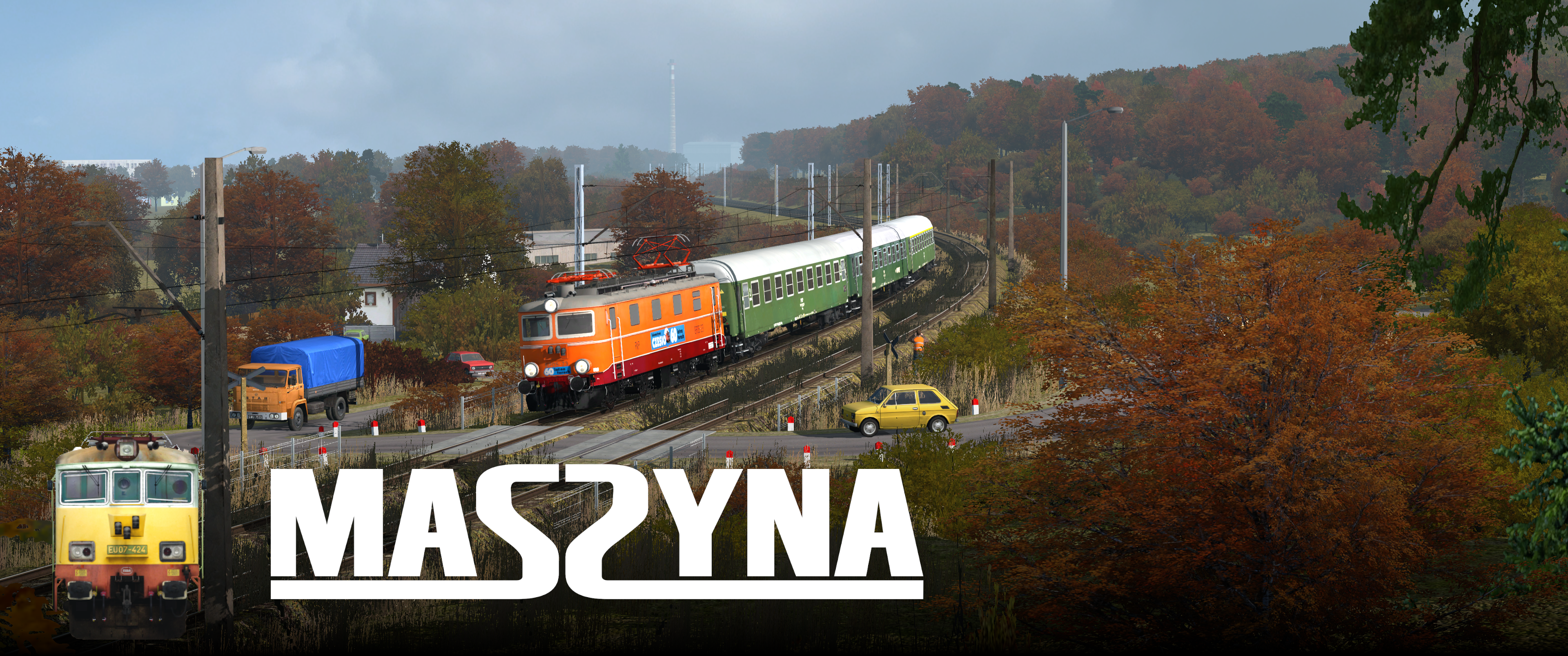
MaSzyna - Railway vehicle simulator
Website · Report an issue · Community Discord · MaSzyna on Steam · MaSzyna on Epic Games Store










MaSzyna executable source code is licensed under the MPL 2.0 and comes with a large pack of free assets under a custom license.
Table of Contents
Getting Started
MaSzyna compiles and runs natively on Linux and Windows. Other platforms are not tested.
Heads-up
Our dev team is small; we keep improving the build process, but issues may still occur. If you get stuck, please ask on the official Discord server.
Prerequisites
For runtime requirements see Minimum Requirements.
1) Software (oldest tested in parentheses)
Note: MinGW is currently not supported.
2) Libraries (oldest tested in parentheses)
-
GLFW 3.x (3.2.1)
If a link error occurs, pass-DGLFW3_LIBRARIES="<path>"to CMake. -
GLM (0.9.9.0)
-
libserialport (0.1.1)
-
libsndfile (1.0.28)
-
LuaJIT (2.0.5)
-
GLEW (2.1.0)
-
libpng (1.6.34)
-
OpenAL (1.18.2)
-
pthread
-
Python 3.14 (64-bit; headers and import library required for embedding)
-
Asio (1.12)
3) Graphics API
- OpenGL 3.0 or newer
- DirectX 12 via NVRHI (optional, Windows only, for Better Renderer)
CMake flags
| Flag | Meaning |
|---|---|
-DCMAKE_BUILD_TYPE=Debug |
Debug build |
-DCMAKE_BUILD_TYPE=Release |
Release build |
-DCMAKE_BUILD_TYPE=RelWithDebInfo |
Release build with debug symbols |
-DWITH_BETTER_RENDERER=ON/OFF |
Enable/disable NVRHI-based renderer |
-DPython3_ROOT_DIR=<path> |
Root of the Python 3.14 install on Windows (python.exe, Lib, DLLs) for embed/copy steps; on Linux, optional if CMake picks the wrong interpreter |
Linux note:
WITH_BETTER_RENDERERuses DirectX 12 through NVRHI and is not supported on Linux.
Windows
Install Python 3.14 x64 from python.org and include the optional Python native development feature (headers and .lib for embedding). Pass -DPython3_ROOT_DIR="C:\Path\To\Python314" on the cmake line when you want the layout under that directory used for embedding and for copying Lib / DLLs next to the executable.
AppVeyor CI builds with the worker image’s preinstalled Python at C:/Python314-x64 (see appveyor.yml: -DPython3_ROOT_DIR=...).
# Clone repository with submodules
git clone --recursive https://github.com/MaSzyna-EU07/maszyna.git

cd maszyna

# Init vcpkg
call setup.bat

# Create directory for CMake build files
mkdir build
cd build

# Generate CMake project (replace %CONFIG% with Debug/Release/RelWithDebInfo)
cmake .. -G "Visual Studio 17 2022" -A x64 -DCMAKE_BUILD_TYPE=%CONFIG%

# Build (replace %CONFIG% accordingly)
cmake --build . --config %CONFIG% --parallel
Linux
# Install dependencies (Fedora/RHEL family)
sudo dnf install -y \
  @development-tools \
  cmake \
  mesa-libGL-devel \
  glew-devel \
  glfw-devel \
  python3.14-devel \
  libpng-devel \
  openal-soft-devel \
  luajit-devel \
  libserialport-devel \
  libsndfile-devel \
  gcc \
  g++ \
  wayland-devel \
  wayland-protocols-devel \
  libxkbcommon-devel

# Clone repository with submodules
git clone --recursive https://github.com/MaSzyna-EU07/maszyna.git

cd maszyna

# Create directory for CMake build files
mkdir build
cd build

# Generate Makefiles (NVRHI is not supported on Linux)
cmake .. -DWITH_BETTER_RENDERER=OFF

# Compile using all cores
make -j"$(nproc)"
Tip (Ubuntu/Debian): Package names differ; install equivalent
build-essential,libgl1-mesa-dev,libglew-dev,libglfw3-dev,python3.14-dev,libpng-dev,libopenal-dev,libluajit-5.1-dev,libserialport-dev,libsndfile1-dev, and Wayland/X11 dev packages as needed.
Installing
There is no make install yet. Copy the built executable to your MaSzyna installation manually.
-
Output directory:
./bin -
File name format:
eu07_YYYY-MM-DD_<commit>[_d]-
YYYY-MM-DD– build date -
<commit>– short commit hash -
_d– present in Debug builds
-
If you already have the MaSzyna assets, copy the executable to the install dir. Assets can be downloaded from eu07.pl.
Rainsted on Linux
If Rainsted (a third‑party starter) fails to detect the executable under Linux, you can create a small wrapper script named eu07.exe:
#!/bin/sh
./eu07 "$1" "$2" "$3" "$4" "$5"
If detection still fails, padding the file (with comments) up to ~1 MB may help.
Known Issues
-
GLFW linking – On some systems you must provide the GLFW library path explicitly with
-DGLFW3_LIBRARIES. -
X11/Wayland linking order – Linking order of X11 and related libs can matter.
-
NVRHI on Linux – The NVRHI/"Better Renderer" path targets DirectX 12 and is currently unsupported on Linux.
Support
-
Official Discord Server: https://discord.gg/qAh9ctWPQv
-
Project page: https://eu07.pl/
Minimum requirements
- OS: Windows 10 64-bit
- Processor: 2 core at least 2 GHz (e.g. Intel Core i3-2100 / AMD Athlon II X2)
- RAM: 6 GB RAM
- Graphics Card: supporting OpenGL 3.3 with at least 1GB VRAM
- 150 GB of free disk space
- Sound card supporting OpenAL with stereo
- Optional COM ports for custom control panel setups.
License
-
Source code: MPL 2.0
-
Assets: Custom license