 791281b306
* test: real vehicles and golden traces in the unit tests

The game's own vehicles (dynamic/ of the release used for the tests) as
JSON of what the game's vehicle loader reads of their .fiz files, includes
expanded: test_fiz.cpp converts them on demand and checks the loader reads
the same sections, values and rows as of the game's file (fiz.h). Chosen
to cover every engine type, brake valve, brake handle, local brake,
coupler type, door type and brake delay set the game data uses.

Golden traces (golden.h) characterise the simulation, compared within a
relative tolerance or exactly, re-recorded with
EU07_UNIT_TESTS_UPDATE_GOLDEN=1:
- the parameters of every real vehicle as loaded,
- the brakes of every real vehicle through charge, service steps,
  release, overcharge and emergency, on every brake delay setting,
- every position of every driver's and local brake handle,
- every powered vehicle started up the way the AI does it, driven to
  full power and braked to a stop (drive.h),
- the real electric units and a locomotive with wagons driven whole, as
  trains of coupled vehicles stepped the way the game steps them
  (consist.h),
- scenarios of the controls (scenario.h): doors, reversing and cab
  change, slip and sand, emergency stops, releasers, the ep and the
  electrodynamic brake, heating, loading, a collision, and frames of
  several physics iterations.

* test: commands passed between vehicles

Every command RunCommand knows run on every real vehicle and recorded,
commands travelling through a train with a vehicle facing backwards, a
coupling without the control cable, and loading and unloading by commands.

* test: every switch of the cab, sent to the next vehicle

Each switch sending its state to the train, each way and to each range,
with the controllers and direction among them, on every real vehicle
driving another of its kind, recorded for both.

* test: the switches of the cab worked on a pair under the catenary

The same switches with two seconds for the vehicles to act on each, so
the pantographs rise, the main switch closes and the auxiliaries start.

* test: gauges of trains in multiple and the damage descriptions

The ammeters and the brake force the AI expects, recorded on the electric
units and locomotives in multiple driven, the damage described on the
driver's panel and ammeters showing the current of controlled vehicles.

* test: give load commands their place, as the game does

The loading test set its commands with SetInternalCommand, which leaves
TCommand::Location as it is: uninitialised in a fresh vehicle, so the
distance check of Load= and UnLoad= read garbage and the test failed
now and then. The game gives them through PutCommand with the place of
the platform, and so do the tests now.

* test: brake valves and handles no vehicle of the game data has

Fitted to a wagon and to an EU07: the valve variants and handles the
loader knows that no real vehicle uses, the CV1 ones and the test handle
among them, and a name the loader doesn't know.

* test: braking from speed with the automatic ED brake, and a draisine

Trains with the EP09, the E6ACT and the EW58 braked by ep, light and full
service applications from speed, and the draisine pumped from rest and
rolling. Only the E6ACT brings its electrodynamic brake in here.

* test: the EP09's electrodynamic brake in service braking held to a stop

start_up() took a vehicle for ready once its line breaker was closed and
its reservoir full, which a train made already moving is at once: the
EP09's manually started converter was never switched on, so there was
no 110 V and no electrodynamic brake. It now waits for the converter.

The EP09 with wagons is braked from 120 km/h by light, medium, high and
full service applications held to a stop: the motors brake, the air of
its cylinders is let out and given back as the train slows down. The
flag of the electrodynamic brake stays on at a standstill below 2.1 bar.

C strings given to CAPTURE are shown as text.

* test: the converter switched on before a train is ready, the EW58's ep-staged electrodynamic brake

start_up() called a train ready as soon as its line breaker closed and the air was there, so the converter
of a unit having it in another car than the cab (the EW58's middle car) was never switched on, and its
electrodynamic brake, gated by the 110 V, never came in. The converter and the compressor now always get
switched on first. The EW58 brakes electrically by the stages of the ep brake, not by the pipe alone.

* test: the ET42 and the 214M railbus among the real vehicles

The ET42's halves (its own series motor branch: the motors in series at the high current setting) and the
214MA, a diesel railbus with the hydraulic torque converter, the retarder and the controller of an induction
motor drive, converted from the game data and recorded in every sweep of the real vehicles.

* test: the wagons' hand brakes released with the train's brakes; the 754, SM31 and SU46

release_brakes() released the hand brake of the driver's vehicle only, so every wagon set up braked kept its
hand brake on and got dragged along. It now releases the hand and spring brakes of the whole train, as
TController::AutoRewident() does when the AI takes it over, and the traces of the trains with wagons are
recorded anew.

The 754, the SM31 and the SU46 join the real vehicles for the kinds of the diesel-electrics' field shunting
relays the others lack (RelayType 0, 1 and 46).

* test: traction on a lost and too high catenary voltage, the ET42, the diesel-electrics' shunting relays

The line breaker opened by the voltage relays of a series motor locomotive and by the limits of an induction
motor one. The ET42 at the high current setting, which keeps its halves' motors in series, and its switched
electrodynamic brake, whose current trips the overload relay from the top speed of the low setting. The field
shunting of the diesel-electrics through each kind of their relays, at full power and notched back.

* test: the EW58's electrodynamic brake stages, the EU47's speed control and braking at the voltage's limit

The stages of the EW58's motor brake set by the positions of its ep handle, the first one alone over
100 km/h. The EU47's second controller holding, raising and lowering the speed set, its local brake setting
the flag of the electrodynamic brake without the motors braking, and its brake feeding back less current into
a catenary over the drive's MaxV.

* test: diesel engines too cold and too hot to start, the 214M railbus's controller and retarder

The heat of the diesel engines: at -10 degrees the ones with the lowest water temperature set don't start
until the heater warms them, at 88 degrees the ones with a second water circuit don't start while it cools,
and the SM42 run hot at full power is kept under its highest temperature by its fans and shutters. The 214M
railbus's controller from the air brake through the retarder and neutral to power, its torque converter's
lock-up and its gearbox.

The controller helpers of the traction tests (full power, waiting for the line contactors, and notching back)
move to test::scenario.

* test: couplers coupled, uncoupled, broken and colliding; loads assigned, loaded and unloaded

Coupling by hand touching or apart and of the same kind or not, with the sounds of what changes; uncoupling a
screw coupler pressed together, stretched, with the hoses alone or broken; the automatic couplers of electric
units coupling on contact, without the control cable between two kinds; a coupler broken with its brake
hose; collisions over 15 km/h derailing. The pantographs set up by the pantstate load, a load of one kind at
a time up to the capacity, and the steps of loading and unloading.

* test: the battery drained and charged, the pantographs' tank and pressure switch, the 214M's speed control

The EU07's battery drained without the converter by the lights and the small compressor until it opens the
line breaker and nothing starts, charged by the converter, and switched off. The pantographs on their own
leaking tank until the pressure switch opens the line breaker, and the small compressor pumping it up and
priming the switch. The 214M railbus's speed control set by its buttons, steps and power limit, braking down
with the retarder, and standing by.

* test: the MHZ handles' buttons, the valves at speed, every brake material, the NESt3's relays

The overload and the high pressure buttons of the MHZ handles. The KE and the LSt at speed in the R and P
settings, under the anti-slip request and the releaser button. Every material of the brake shoes and disks
the loader takes, braking a wagon from speed, the ones no game vehicle has among them. The CV1_R and the
Oerlikon valve's relays set by its name (-ED, AL2 without ESt3) fitted to a wagon.

* test: the loader's lists and lines: the 218M, SA134 and 22WEc, a compressor list, Pmax by speed, skipped lines

The 218M (V2NList), the SA134 (HTCList) and the Elf 22WEc (ffBrakeList) join the real vehicles for the lists
the others lack. Definitions made by the tests for what no game file has: a compressor list, whose table of
whole numbers reads a factor of 0.9 as 0; the compressor's limits apart for the rear cab; the highest power
of an induction motor drive by the speed, extrapolated past the table; and the lines the loader skips or
trims (comments, a hash anywhere, leading spaces, carriage returns).

* test: what the cab and the AI call on a vehicle: gauges of the train, the split ED brake, spring brake, cut-off

The engine rotation of up to three vehicles in multiple and the lamps of the overload relay and the starting
resistors read through the control cable; the engine's idle speed and the ET42's second controller shown in
its dynamic brake; the controller of the electrodynamic brake apart from the local brake, which no game
vehicle has yet; the spring brake shut off and released, the ep brake's fuse and the handle stepped by the AI;
damaged motors cut off; the cab activated by itself; a road vehicle moved across a road, for which the tests'
track gets a width; and the lamps and the buzzer of the security system left unattended.

* test: the EP05 and its camshaft among the real vehicles, the headlights' colour and brightness

The EP05, whose camshaft closes the line breaker and the line contactors by the camshaft's own position,
converted from the game data and recorded in every sweep of the real vehicles. The Headlights section, which
only the 214M's own file has, in a definition made by the test.

* test: what the unit tests reach of the simulation core, what's dead or left, and what they found

COVERAGE.md: the blocks of Mover.cpp, hamulce.cpp, Oerlikon_ESt.cpp and friction.cpp the tests run, the code
nothing in the game runs, the code only data no game vehicle has would run, what's reachable and left, and
the behaviour the tests found that may deserve a look.

* test: check invariants of the physics on every step of every golden trace

Rules any vehicle keeps whatever a test does (no NaN, cylinders and pipes
within their limits, no current with the line breaker or contactors open,
no force without power, distance as the speed runs, no acceleration over
5 g), checked on every step, with no comparison to a recorded file. The
traces where a test or a game vehicle breaks one are excused with the
reason; the vehicles' cases are in the findings of COVERAGE.md.

* test: key figures of every golden trace, per part of the run

Duration, speeds, distance, time to stop, the brake pipe's lowest
pressure and time to recover, the peaks of the cylinders, the motor
current and the tractive force, for each part between two events, in
data/golden/<name>.figures. Compared within 0.5% or the last decimal, so
they hold on any compiler, and an intended change of behaviour shows in
a few readable lines. Traces sampled by hand keep none.

* test: keep the golden samples out of the repository, recorded on the code before a change

The samples of the golden traces are 29 MB and only mean something against
the code before the change they check, so they're recorded locally before it
(EU07_UNIT_TESTS_UPDATE_GOLDEN=1) and compared after it, and ignored by git.
The key figures and the invariants stay, and are what the CI checks.

Without samples recorded a trace compares only its key figures, but with
EU07_UNIT_TESTS_GOLDEN_EXACT=1, the check of a change which shouldn't alter
anything, it fails, so the check can't pass by having nothing to compare.

* fix: draw the noise of the control pipe pressure in one order on every compiler

The order of the two Random(10) calls in 'Random(10) - Random(10)' is
unspecified: GCC draws them the other way round than MSVC Release, which
mirrored the control pipe pressure around 5 bar and failed 32 unit tests
on the Linux CI. The draws are sequenced in the order of MSVC Release,
which the golden traces were recorded with.

* test: count the start-up rounds with an integer, not a double (SonarCloud S2193)

* test: behaviour in CHECKs, the key figures out of the repository

The key figures of the golden traces are recorded with their samples on the code
before a change, and compared after it, instead of being kept: a trace without
them checks the invariants and its test's CHECKs, which is what the CI runs.

The scenarios of the controls state what they show in CHECKs, and the runs of
every real vehicle what holds for each of them. Writing them showed scenarios
which didn't do what they were named for: the cab change stopped in the engine
room, the slip runs put the controller to full power at once and never got the
line contactors closed, and the train stopped by the alarm chain never got its
pipe charged again. They do it now; the rest went to the findings.

* refactor: TractionForce split into its parts and a function per kind of engine

TractionForce() makes the engine's revolutions, the ventilators, the engine power
and the voltage relays in turn, then the tractive force of its kind of engine, each
in a function of its own: the dumb, wheels driven, series motor (with its dynamic
brake by stages), diesel, diesel-electric (with the shunt field relays) and
induction motor drives (its speed control, brake blending, motor model and the
drive without power).

The blocks moved line for line; the golden traces of the unit tests, recorded on
the code before, compare bit for bit.

* refactor: the shunt field relays of types 45 and 46 in functions of their own

* refactor: RunCommand split by the area of its commands

The controllers, the brakes, the auxiliaries, the power, the doors and the load each in a function of its own; RunCommand() asks them in turn. The branches moved line for line, and the commands are distinct, so the order of the groups changes nothing; the golden traces compare bit for bit.

* refactor: the line loop of LoadFIZ_Parse split into table ends, sections and table rows

Each part returns where the loop went on to the next line; the dimmer list's row, which never did, still falls through to the next table. The blocks moved line for line, continue became return; every real vehicle loads the same parameters.

* refactor: CheckEIMIC split by the kind of the integrated controller

The controller, the steps, the four positions and the universal controller each in a function of its own, besides the TRAXX local brake and the limit of the value. The blocks moved line for line; the golden traces compare bit for bit.

* refactor: update_doors split into the requests, the movement and the timers of the doors

The blocks moved line for line; the golden traces, the doors of the units and wagons among them, compare bit for bit.

* refactor: UpdatePipePressure split into its valves

The local brake valve, the driver's handle with the pipe lock, the emergency valve, the settings of the distributor and the ep brake of the FVel6 handles each in a function of its own. The blocks moved line for line; the golden traces compare bit for bit.

* refactor: PowerCouplersCheck split into the local voltage, the voltages and the currents of the couplers

The circuit of a coupler for the coupling being checked comes from TCoupling::power() instead of a nested conditional repeated five times. The blocks moved line for line; the golden traces compare bit for bit.

* refactor: CheckLocomotiveParameters split into the brake parts it creates and the state it starts in

The distributor valve, the handles, the pipes, and the vehicle ready to depart or braked each in a function of its own; the main pipe's starting pressure comes from InitialScndPipePress() instead of a nested conditional. The blocks moved line for line; every real vehicle loads and runs the same, bit for bit.

* refactor: AutoRelayCheck split into the steps of the shunt field, the main relays and the line contactors

Each step returns whether it moved, as OK was; the early returns of the main relays' step give false as before, so the relay timer isn't reset after them either. The blocks moved line for line; the golden traces compare bit for bit.

* refactor: LoadFIZ_Cntrl and LoadFIZ_Engine split into their parts

Cntrl. into the brakes, the controllers and the starts of the devices; Engine: into the diesel, diesel-electric and induction motor parts and what both diesels share. The blocks moved line for line; every real vehicle loads the same, and the golden traces compare bit for bit.

* refactor: the steps of the main controller by the kind of the engine in functions of their own

IncMainCtrl() and DecMainCtrl() keep the conditions common to all, the switch on the engine moved line for line to IncMainCtrlByEngine() and DecMainCtrlByEngine(). An early return false there gives OK false, after which nothing else happened before either. The golden traces compare bit for bit.

* refactor: dizel_AutoGearCheck and Current split into their parts

The automatic gearbox's shift and its clutch; the series motors' dynamic brake flag, their current when connected and their failures. The blocks moved line for line; the golden traces compare bit for bit.

* refactor: dizel_fillcheck split into the integrated controller's fill and the governor

The blocks moved line for line; the golden traces compare bit for bit.

* refactor: the diesel-electric's generator and the camshaft's run-down in functions of their own

DieselElectricTractionForce() keeps the tractive force, the generator's current and voltage and the shunting mode's power limit moved out; AutoRelayLineContactorsStep() keeps the line contactors, the camshaft's run back to zero moved out, which only ever sets OK. The blocks moved line for line; the golden traces compare bit for bit.

* refactor: the battery's drain in a function of its own

UpdateBatteryVoltage() takes the drop BatteryDrain() sums up as it did. The blocks moved line for line; the golden traces, the drained battery's among them, compare bit for bit.

* refactor: the speed control's regulator, and the couplers' stretch and automatic coupling, in functions of their own

CheckSpeedCtrl() keeps the standby and the turn-off, its PI regulator moved out; CouplerForce() keeps the forces, the breaking of a stretched coupler and the coupling on contact moved out. The blocks moved line for line; the golden traces, the couplers tests' among them, compare bit for bit.

* refactor: the pantographs' pressure switch and the torque converter in functions of their own

UpdatePantVolume() keeps the pantographs' air, its pressure switch moved out; dizel_Momentum() keeps the engine's and clutches' moments, the converter's fill and lockup and its moments moved out. The blocks moved line for line; the golden traces compare bit for bit.

* test: the SonarCloud findings in the unit tests

std::format for the texts put together, emplace_back, const references, string_view parameters, std::array and std::vector for the C arrays, the ranges algorithms, names no longer shadowing the coupler ends, comments in the empty loops; start_up(), trace::check() and the converter of the definitions split up. BrakeForceR() is const, which it always was in effect, so the gauges test needs no const_cast. The golden traces compare bit for bit.

* refactor: the simple SonarCloud findings in Mover.cpp

const where the functions change nothing of the vehicle, using enum, a const reference, init-statements, a value never read and an unused parameter dropped, the never read lines of the definition kept in a map with a transparent comparator, the cooling power's default set before it's read. The golden traces compare bit for bit.

* refactor: the command groups and the sections of the definition split further

RunCommand() asks the pumps, the blowers, the cab and the brake equipment as groups of their own; the doors' permit and remote opening and closing are functions of their own, the latter one for both; LoadFIZ_Section() keeps the sections of values, those opening tables moved to LoadFIZ_TableSection(). No section name begins another, so the order of the checks changes nothing. The golden traces compare bit for bit.

* refactor: the doors' requests and the main relays' steps split further

update_door_requests() asks door_open_request(), door_close_request(), doors_powered(), door_step_folding() and door_open_duration() for what its nested expressions worked out; AutoRelayMainStep() asks AutoRelayMainUp(), AutoRelayMainNotchUp() and AutoRelayMainDown(), and is indented as it should be. The golden traces compare bit for bit.

* refactor: the battery's drain by its state, and the series motors' notches, in functions of their own

BatteryDrain() asks BatteryDrainCharged(), BatteryDrainLow() and BatteryDrainSwitchedOff(), each summing the drains as before; the series motors' cases of IncMainCtrlByEngine() and DecMainCtrlByEngine() moved out, and the condition of a notch down by one which was true either way made plain. The golden traces compare bit for bit.

* refactor: the universal controller's brake, the clutch, the EN57's camshaft and the driver's handle's supply in functions of their own

The blocks moved line for line; the golden traces compare bit for bit.

* refactor: the induction motors' speed control, brake blending and drive split further

The speed control by time and by position, the electrodynamic brake's flag and share, the motors' force limits and the inverters' frequency each in a function of its own. The blocks moved line for line; the golden traces compare bit for bit.

* refactor: the diesel-electric's characteristic in a function of its own

The straight part and the hyperbola of the tractive force, worked out the same way for the integrated controller and the train mode, in DieselElectricForce(). The golden traces compare bit for bit.

* refactor: the resistor blowers, the diesel-electric's target revolutions, the gearbox's request and the governor's revolutions in functions of their own

The blocks moved line for line, and the governor's body is indented as it should be; the golden traces compare bit for bit.

* refactor: the series motors' driving current, the pressure switch's trip, the shunt relays, the Cntrl. train brake and the couplers' current split further

The blocks moved line for line; the anti-slip brake's kinds read without the nested conditions, the circuit's current picked by PowerCircuitCurrent() instead of a nested conditional, and the couplers' voltage summed through TCoupling::power(). The golden traces compare bit for bit.

* refactor: the nesting Sonar found left in the series motors' current, the pressure switch and the diesel-electric

The series motors' dynamic brake without the condition every braking vehicle passed, the pressure switch's priming as an else-if, the integrated controller's force of the diesel-electric in a function of its own. The golden traces compare bit for bit.

* refactor: the GetPF() of the EStED and LSt valves split into their state, releaser and cylinders

The blocks moved line for line; the golden traces of every real vehicle's brakes compare bit for bit.

* refactor: the KE valve's cylinders and its held state in functions of their own

The blocks moved line for line; the golden traces compare bit for bit.

* refactor: the FV4a handle's chambers, wave and reductor in functions of their own

The blocks moved line for line; the golden traces of every handle position compare bit for bit.

* refactor: the MHZ_EN57 handle's time reservoir and supply pressure in functions of their own

The blocks moved line for line; the golden traces compare bit for bit.

* refactor: the EP2 valve's state and the ESt valve's held state in functions of their own

The blocks moved line for line; the golden traces compare bit for bit.

* refactor: the relays' commands and the diesel-electric's shunting force split out

The blocks moved line for line; the golden traces compare bit for bit.

* test: the SonarCloud findings in the unit tests

std::format for the texts put together, emplace_back, const references, string_view parameters, std::array and std::vector for the C arrays, the ranges algorithms, names no longer shadowing the coupler ends, comments in the empty loops; start_up(), trace::check() and the converter of the definitions split up. BrakeForceR() is const, which it always was in effect, so the gauges test needs no const_cast. The golden traces compare bit for bit.

* refactor: the SonarCloud findings left in Mover.cpp and hamulce.cpp

The EStED's intermediate flow is computed by a const function and its caller fills the reservoir; the anti-slip brake's kind is read from a string_view; the doors' remote command no longer shadows the enumerator control; the diesel-electric's tractive force and the camshaft's run-down nest less. The golden traces compare bit for bit.

* refactor: the door helpers aren't const, the door they change is the vehicle's own

* refactor: the power couplers' voltage and current return early for a coupling which isn't a power one
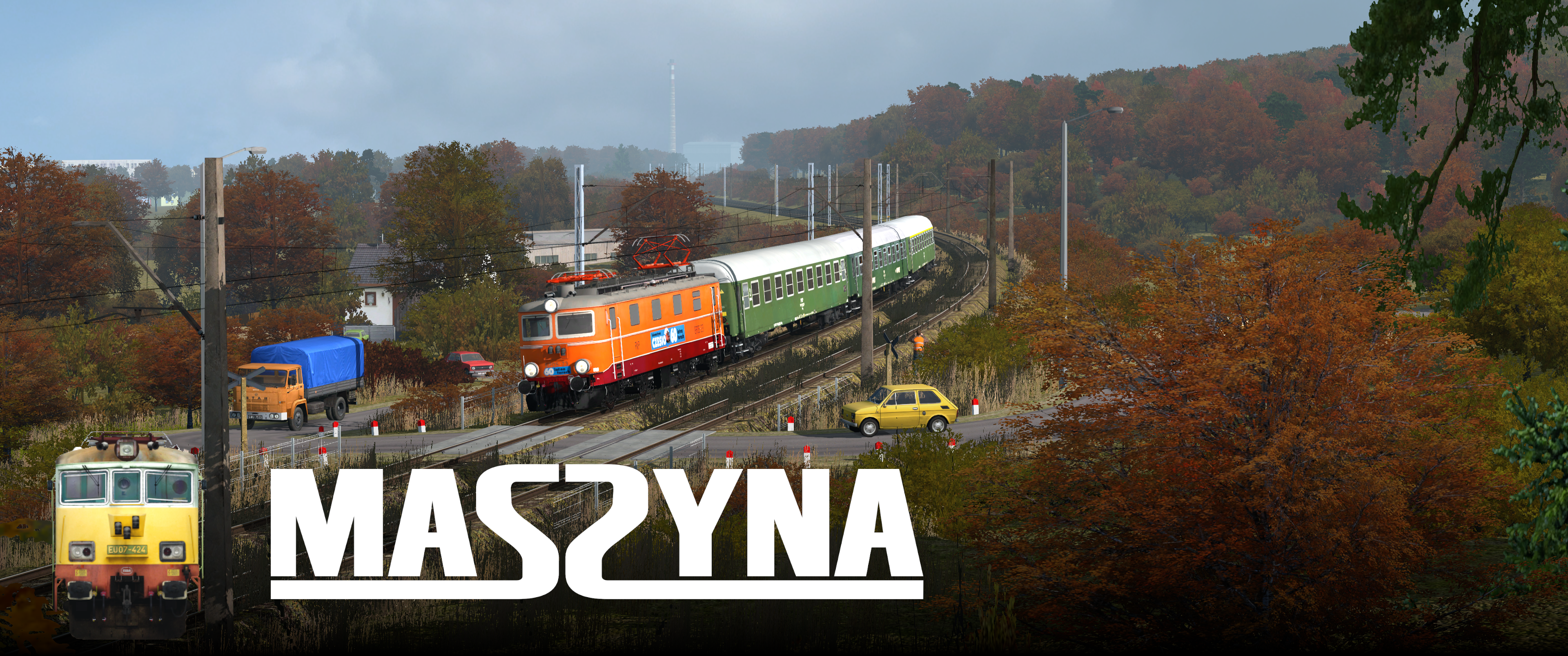
MaSzyna - Railway vehicle simulator
Website · Report an issue · Community Discord · MaSzyna on Steam · MaSzyna on Epic Games Store














MaSzyna executable source code is licensed under the MPL 2.0 and comes with a large pack of free assets under a custom license.
Table of Contents
Getting Started
MaSzyna compiles and runs natively on Linux and Windows. Other platforms are not tested.
Heads-up
Our dev team is small; we keep improving the build process, but issues may still occur. If you get stuck, please ask on the official Discord server.
Prerequisites
For runtime requirements see Minimum Requirements.
1) Software (oldest tested in parentheses)
Note: MinGW is currently not supported.
2) Libraries (oldest tested in parentheses)
-
GLFW 3.x (3.2.1)
If a link error occurs, pass-DGLFW3_LIBRARIES="<path>"to CMake. -
GLM (0.9.9.0)
-
libserialport (0.1.1)
-
libsndfile (1.0.28)
-
LuaJIT (2.0.5)
-
GLEW (2.1.0)
-
libpng (1.6.34)
-
OpenAL (1.18.2)
-
pthread
-
Python 3.14 (64-bit; headers and import library required for embedding)
-
Asio (1.12)
3) Graphics API
- OpenGL 3.0 or newer
- DirectX 12 via NVRHI (optional, Windows only, for Better Renderer)
CMake flags
| Flag | Meaning |
|---|---|
-DCMAKE_BUILD_TYPE=Debug |
Debug build |
-DCMAKE_BUILD_TYPE=Release |
Release build |
-DCMAKE_BUILD_TYPE=RelWithDebInfo |
Release build with debug symbols |
-DWITH_BETTER_RENDERER=ON/OFF |
Enable/disable NVRHI-based renderer |
-DPython3_ROOT_DIR=<path> |
Root of the Python 3.14 install on Windows (python.exe, Lib, DLLs) for embed/copy steps; on Linux, optional if CMake picks the wrong interpreter |
Linux note:
WITH_BETTER_RENDERERuses DirectX 12 through NVRHI and is not supported on Linux.
Windows
Install Python 3.14 x64 from python.org and include the optional Python native development feature (headers and .lib for embedding). Pass -DPython3_ROOT_DIR="C:\Path\To\Python314" on the cmake line when you want the layout under that directory used for embedding and for copying Lib / DLLs next to the executable. The cab screens are drawn with Pillow: install it into that Python (python -m pip install Pillow) before building, so it is copied along with Lib.
AppVeyor CI builds with the worker image’s preinstalled Python at C:/Python314-x64 (see appveyor.yml: -DPython3_ROOT_DIR=...).
# Clone repository with submodules
git clone --recursive https://github.com/MaSzyna-EU07/maszyna.git

cd maszyna

# Init vcpkg
call setup.bat

# Create directory for CMake build files
mkdir build
cd build

# Generate CMake project (replace %CONFIG% with Debug/Release/RelWithDebInfo)
cmake .. -G "Visual Studio 17 2022" -A x64 -DCMAKE_BUILD_TYPE=%CONFIG%

# Build (replace %CONFIG% accordingly)
cmake --build . --config %CONFIG% --parallel
Linux
# Install dependencies (Fedora/RHEL family)
sudo dnf install -y \
  @development-tools \
  cmake \
  mesa-libGL-devel \
  glew-devel \
  glfw-devel \
  python3.14-devel \
  libpng-devel \
  openal-soft-devel \
  luajit-devel \
  libserialport-devel \
  libsndfile-devel \
  gcc \
  g++ \
  wayland-devel \
  wayland-protocols-devel \
  libxkbcommon-devel

# Clone repository with submodules
git clone --recursive https://github.com/MaSzyna-EU07/maszyna.git

cd maszyna

# Create directory for CMake build files
mkdir build
cd build

# Generate Makefiles (NVRHI is not supported on Linux)
cmake .. -DWITH_BETTER_RENDERER=OFF

# Compile using all cores
make -j"$(nproc)"
Tip (Ubuntu/Debian): Package names differ; install equivalent
build-essential,libgl1-mesa-dev,libglew-dev,libglfw3-dev,python3.14-dev,libpng-dev,libopenal-dev,libluajit-5.1-dev,libserialport-dev,libsndfile1-dev, and Wayland/X11 dev packages as needed.
Installing
There is no make install yet. Copy the built executable to your MaSzyna installation manually.
-
Output directory:
./bin -
File name format:
eu07_YYYY-MM-DD_<commit>[_d]-
YYYY-MM-DD– build date -
<commit>– short commit hash -
_d– present in Debug builds
-
If you already have the MaSzyna assets, copy the executable to the install dir. Assets can be downloaded from eu07.pl.
Rainsted on Linux
If Rainsted (a third‑party starter) fails to detect the executable under Linux, you can create a small wrapper script named eu07.exe:
#!/bin/sh
./eu07 "$1" "$2" "$3" "$4" "$5"
If detection still fails, padding the file (with comments) up to ~1 MB may help.
Known Issues
-
GLFW linking – On some systems you must provide the GLFW library path explicitly with
-DGLFW3_LIBRARIES. -
X11/Wayland linking order – Linking order of X11 and related libs can matter.
-
NVRHI on Linux – The NVRHI/"Better Renderer" path targets DirectX 12 and is currently unsupported on Linux.
Support
-
Official Discord Server: https://discord.gg/qAh9ctWPQv
-
Project page: https://eu07.pl/
Minimum requirements
- OS: Windows 10 64-bit
- Processor: 2 core at least 2 GHz (e.g. Intel Core i3-2100 / AMD Athlon II X2)
- RAM: 6 GB RAM
- Graphics Card: supporting OpenGL 3.3 with at least 1GB VRAM
- 150 GB of free disk space
- Sound card supporting OpenAL with stereo
- Optional COM ports for custom control panel setups.
License
-
Source code: MPL 2.0
-
Assets: Custom license