 10c7527a64
* feat(ai): reduced signal speed ends at a marked end of the interlocking area

Ie-1 (from 17.01.2026, signals on colour light signals, par. 8): a reduced
speed shown by a signal (S10 "40, then Vmax" and the like) holds to the end
of the interlocking area the signal guards. Only on secondary main tracks
does it hold for the whole route, and on semaphore signals (Sr3) at an entry
or route signal 40 holds for the whole route as well.

The AI kept the speed of the passed signal (VelSignalLast) until it passed
the next signal, or until no signal, switch or W4 was left in the scan. On a
station the exit signal, the far switches and the W4 are always in the scan,
so after S10 at the entry signal onto the principal main track the AI ran 40
all the way to the exit signal.

A scenery can now mark where the interlocking area ends, with a putvalues
event read by the scan like a signal:

  event <name> putvalues 0 none x y z SignalAreaEnd 0 0 endevent

attached to event1/event2 of the track (the direction the train runs), past
the last switch of the area, on the principal main track only. In train mode
the reduced speed of the passed signal ends once the rear of the train is
past the marker, i.e. the whole train has left the switches. A signal at
stop passed (speed 0) is not lifted. The marker sends no command and is not
treated as a signal or a speed limit: it does not end the restricted run on
sight after S1 on automatic block, and it means nothing in shunting. The
driver hint for the end of the speed limit uses the marker when there is one
instead of the farthest switch in the scan.

Where the marker is left out (secondary main tracks, stations with semaphore
signals, every existing scenery) the speed holds as before.

Game data: nothing has to change in the SVN for this to work. Sceneries may
add the marker; a release without this change does not read SignalAreaEnd
(an unknown putvalues command is not scanned), so it ignores it.

* fix(ai): a marker behind the last passed signal does not end its speed

The marker acted on whatever speed the last passed signal had left when the
rear of the train passed it. A train longer than the way from the marker to
the next signal, or one which started standing over the marker (scenario
start at a platform, a direction change), had its head past the next signal
before its rear was past the marker of the previous area, and the marker
then lifted the 40 of the new signal while the head ran through its
switches. Passing a signal now drops the markers that lie before it in the
scan table: they end the area of an earlier signal.

In shunting the marker is no longer thrown away when the rear passes it, so
a train order given before the next signal still finds it.

A note to the previous commit: a release without SignalAreaEnd does not scan
the marker, it runs it as an ordinary putvalues event when a vehicle passes,
which logs it and sends the mover a command it does not know, to no effect.

* AI: a higher road speed (W27/W27a) takes effect once the rear is past the sign (#306)

* fix(ai): a higher road speed (W27) holds only once the rear is past the sign

The road speed of a RoadVelocity event (W27/W27a) took effect as soon as
the head of the train passed the sign, both a lower and a higher one, and
the entry left the scan table in the same pass. A lower speed from the head
is right: the AI brakes before the sign, it is in the scan. A higher one let
the AI speed up while the rest of the train was still on the stretch of the
lower speed.

Now a higher road speed (compared through min_speed, so -1 is no limit)
holds once the whole train is past the sign. Until then the entry stays in
the table and is left out of the rest of the table update, which would have
dropped it. What the update did to a passed passive event when it dropped
it (command, VelSignal, the end of the restricted run on sight) now happens
when the rear passes the sign instead of the head. One-way signs and 2w27
stay as they were: the scan reads only the event of the running direction.

The comments of the road speed and section speed branches named them W6
and W27; they are W27/W27a and W9.

* fix(ai): road speed of cars from the head, W27 does not end the run on sight

Two faults of the previous commit, found in review:

A car's passed events leave the scan table at the latest when its rear
passes them (TableCheck), before the table update could see the rear past
the sign, so an AI car never took a higher road speed and kept the lowest
one for good. A car takes the road speed from the head again, as before.

With the sign now kept in the table until the rear passes it, the generic
handling of a passed passive event ran only then, and it ends the run on
sight after S1 on automatic block. A train which stopped at S1 with its rear
not yet past a W27 lying shortly before the signal would, once on the move,
end the run on sight and run into the occupied block at road speed. A road
speed sign is no signal: it no longer ends the run on sight at all, which
also ends the same thing happening, before this branch, to a train whose
head passed a W27 while running on sight.

* fix(ai): a passed road speed sign is handled when the head passes it, as before

The previous commit left a road speed sign out of the table update until
the rear passed it, so the generic handling of a passed passive event (the
SetVelocity command, VelSignal, the end of the run on sight) ran up to one
train length later than before. By then the order may have changed: a
train standing over a W27 at its last station, with Shunt as its next
order, would be switched back to Obey_train by that command once its rear
passed the sign on the next forward move.

Now the sign is handled as before in the first pass after the head passes
it. In place of dropping it from the table it is then marked as held
(spRoadVelHeld) and only waits for the rear, left out of the rest of the
update. So everything but the moment a higher road speed takes effect is as
it was, and the change of the previous commit that kept a W27 from ending
the run on sight is undone: it is not needed any more.

A car is told by CategoryFlag == 2, the same test TableCheck drops its
passed events by, so a unimog (rail and road) holds the sign for its rear
like a train.

* fix(ai): a road speed released by the rear doesn't exceed a lower sign after it the head has passed

A train longer than the distance between two road speed signs, as W27a
120 and then W27a 60, passes the 60 with its head before its rear is
past the 120. Releasing the 120 then set the road speed to 120, and only
the held 60 handled later in the same table pass brought it back down,
so the result depended on the order of the table and on the loop
reaching that entry (it stops at the first point that orders a stop).

When the rear passes a sign, the road speed is now the lowest of that
sign and of the signs after it that the head has passed and the rear
not yet. Without such a sign it is set as before.

* fix(ai): a passed road speed sign not yet marked as held caps the released one too

The sign after the released one may have been passed by the head in
the very tick the rear passes the released one, before the table update
marks it as held. It is now taken into the lowest speed as well (an
enabled road speed entry behind the head), so the result doesn't depend
on the table update reaching it in that tick.

---------

Co-authored-by: maj00r <maj00r@host>

---------

Co-authored-by: maj00r <maj00r@host>
Co-authored-by: jerrrrycho <jurek.pakula@gmail.com>
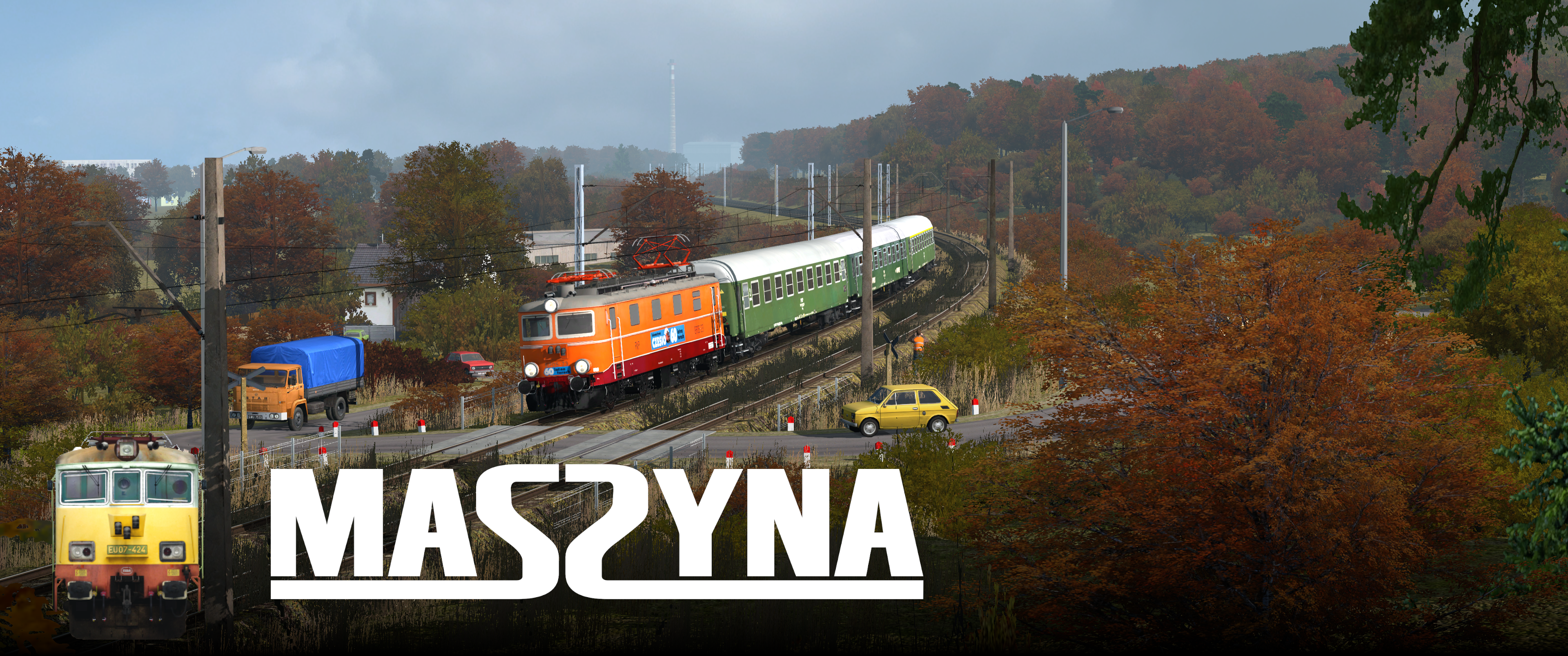
MaSzyna - Railway vehicle simulator
Website · Report an issue · Community Discord · MaSzyna on Steam · MaSzyna on Epic Games Store










MaSzyna executable source code is licensed under the MPL 2.0 and comes with a large pack of free assets under a custom license.
Table of Contents
Getting Started
MaSzyna compiles and runs natively on Linux and Windows. Other platforms are not tested.
Heads-up
Our dev team is small; we keep improving the build process, but issues may still occur. If you get stuck, please ask on the official Discord server.
Prerequisites
For runtime requirements see Minimum Requirements.
1) Software (oldest tested in parentheses)
Note: MinGW is currently not supported.
2) Libraries (oldest tested in parentheses)
-
GLFW 3.x (3.2.1)
If a link error occurs, pass-DGLFW3_LIBRARIES="<path>"to CMake. -
GLM (0.9.9.0)
-
libserialport (0.1.1)
-
libsndfile (1.0.28)
-
LuaJIT (2.0.5)
-
GLEW (2.1.0)
-
libpng (1.6.34)
-
OpenAL (1.18.2)
-
pthread
-
Python 3.14 (64-bit; headers and import library required for embedding)
-
Asio (1.12)
3) Graphics API
- OpenGL 3.0 or newer
- DirectX 12 via NVRHI (optional, Windows only, for Better Renderer)
CMake flags
| Flag | Meaning |
|---|---|
-DCMAKE_BUILD_TYPE=Debug |
Debug build |
-DCMAKE_BUILD_TYPE=Release |
Release build |
-DCMAKE_BUILD_TYPE=RelWithDebInfo |
Release build with debug symbols |
-DWITH_BETTER_RENDERER=ON/OFF |
Enable/disable NVRHI-based renderer |
-DPython3_ROOT_DIR=<path> |
Root of the Python 3.14 install on Windows (python.exe, Lib, DLLs) for embed/copy steps; on Linux, optional if CMake picks the wrong interpreter |
Linux note:
WITH_BETTER_RENDERERuses DirectX 12 through NVRHI and is not supported on Linux.
Windows
Install Python 3.14 x64 from python.org and include the optional Python native development feature (headers and .lib for embedding). Pass -DPython3_ROOT_DIR="C:\Path\To\Python314" on the cmake line when you want the layout under that directory used for embedding and for copying Lib / DLLs next to the executable. The cab screens are drawn with Pillow: install it into that Python (python -m pip install Pillow) before building, so it is copied along with Lib.
AppVeyor CI builds with the worker image’s preinstalled Python at C:/Python314-x64 (see appveyor.yml: -DPython3_ROOT_DIR=...).
# Clone repository with submodules
git clone --recursive https://github.com/MaSzyna-EU07/maszyna.git

cd maszyna

# Init vcpkg
call setup.bat

# Create directory for CMake build files
mkdir build
cd build

# Generate CMake project (replace %CONFIG% with Debug/Release/RelWithDebInfo)
cmake .. -G "Visual Studio 17 2022" -A x64 -DCMAKE_BUILD_TYPE=%CONFIG%

# Build (replace %CONFIG% accordingly)
cmake --build . --config %CONFIG% --parallel
Linux
# Install dependencies (Fedora/RHEL family)
sudo dnf install -y \
  @development-tools \
  cmake \
  mesa-libGL-devel \
  glew-devel \
  glfw-devel \
  python3.14-devel \
  libpng-devel \
  openal-soft-devel \
  luajit-devel \
  libserialport-devel \
  libsndfile-devel \
  gcc \
  g++ \
  wayland-devel \
  wayland-protocols-devel \
  libxkbcommon-devel

# Clone repository with submodules
git clone --recursive https://github.com/MaSzyna-EU07/maszyna.git

cd maszyna

# Create directory for CMake build files
mkdir build
cd build

# Generate Makefiles (NVRHI is not supported on Linux)
cmake .. -DWITH_BETTER_RENDERER=OFF

# Compile using all cores
make -j"$(nproc)"
Tip (Ubuntu/Debian): Package names differ; install equivalent
build-essential,libgl1-mesa-dev,libglew-dev,libglfw3-dev,python3.14-dev,libpng-dev,libopenal-dev,libluajit-5.1-dev,libserialport-dev,libsndfile1-dev, and Wayland/X11 dev packages as needed.
Installing
There is no make install yet. Copy the built executable to your MaSzyna installation manually.
-
Output directory:
./bin -
File name format:
eu07_YYYY-MM-DD_<commit>[_d]-
YYYY-MM-DD– build date -
<commit>– short commit hash -
_d– present in Debug builds
-
If you already have the MaSzyna assets, copy the executable to the install dir. Assets can be downloaded from eu07.pl.
Rainsted on Linux
If Rainsted (a third‑party starter) fails to detect the executable under Linux, you can create a small wrapper script named eu07.exe:
#!/bin/sh
./eu07 "$1" "$2" "$3" "$4" "$5"
If detection still fails, padding the file (with comments) up to ~1 MB may help.
Known Issues
-
GLFW linking – On some systems you must provide the GLFW library path explicitly with
-DGLFW3_LIBRARIES. -
X11/Wayland linking order – Linking order of X11 and related libs can matter.
-
NVRHI on Linux – The NVRHI/"Better Renderer" path targets DirectX 12 and is currently unsupported on Linux.
Support
-
Official Discord Server: https://discord.gg/qAh9ctWPQv
-
Project page: https://eu07.pl/
Minimum requirements
- OS: Windows 10 64-bit
- Processor: 2 core at least 2 GHz (e.g. Intel Core i3-2100 / AMD Athlon II X2)
- RAM: 6 GB RAM
- Graphics Card: supporting OpenGL 3.3 with at least 1GB VRAM
- 150 GB of free disk space
- Sound card supporting OpenAL with stereo
- Optional COM ports for custom control panel setups.
License
-
Source code: MPL 2.0
-
Assets: Custom license