 e2abe0384f
* test(scenarios): heavy trains on gradients, the limits #187, #199, #263 and #265 left

Cases on lines of their own beside td.scn, built the way the downgrade
fragment of #479 is (x = -3000, a substation of their own, signals that
are a memory cell with SetVelocity 0 0), with level track long enough
for a whole heavy consist at the start:

- et41_coal_td_downgrade_restriction: ET41 + 25 coal wagons (1670 t)
  down 20 per mille into a 20 km/h restriction. Staging: 10.5 km/h at
  the lowest, stops at the signal. #263 saw it stop before the
  restriction; it no longer does.
- et22_764_td_downgrade_restriction: ET22 + 20 loaded 764 (2650 t) on
  the same line. xfail: it dips to 8.5 km/h in the restriction, as the
  AI applies and releases the train brake in turn and the release of a
  G train takes 10-15 s.
- st43_steel_td_downgrade12_long: ST43 + 45 425S, 6.5 km down 12 per
  mille at 40 km/h (#199): 35-37.5 km/h all the way.
- et41_coal_td_upgrade_start: the ET41 train stops at a signal on 10 per
  mille and starts when it clears (#265): moves off 4.7 s later, rolls
  back 0.04 m.
- eu07a_coaches_td_upgrade_long: EU07A + 8 coaches up 10 per mille at
  80 km/h (#187): never below 73.8 km/h.

run.py gets two checks: keeps_moving (the lowest vehicle speed between
two distances) and starts_again (a start from a signal that clears at
a given time, with the rollback). The README lists the cases and what
the AI still does with heavy trains.

* fix(ai): a heavy train starting on poor rails keeps sanding and takes the power down a step at a time

An ET41 with 25 loaded coal wagons (2170 t) starting on level track with
friction 0.3 (#187: heavy trains often don't get going on such rails)
moved 75 m in 1500 s, never above 1 km/h, with 395 slips. Each slip made
control_wheelslip() take the power down on every update while the
wheels spun (DecSpeed(), two notches each: 3 to 0 within half a
second) and press the anti-slip brake (1.1 bar on the locomotive),
which braked the train, just moving, to a stand. Once the wheels
gripped, the sand went off at once, as it stays on ahead of a slip
only at a high motor current, and the start began anew from notch 1.

A slip under power below 15 km/h now makes the start a sanded one until
the train is at 15 km/h, or stands with no speed asked for: the sand
stays on while there is power, a slip takes the power down one step at
most once a second, and the anti-slip brake isn't used. A slip at speed,
or one without power, is handled as before.

The same train now gets going and stops at the signal 1000 m ahead
(392 s, 85 slips). New case et41_coal_td_slippery_start
(td_level_signal.scn); it fails on staging.

* fix(ai): a sanded start only on a vehicle with sand
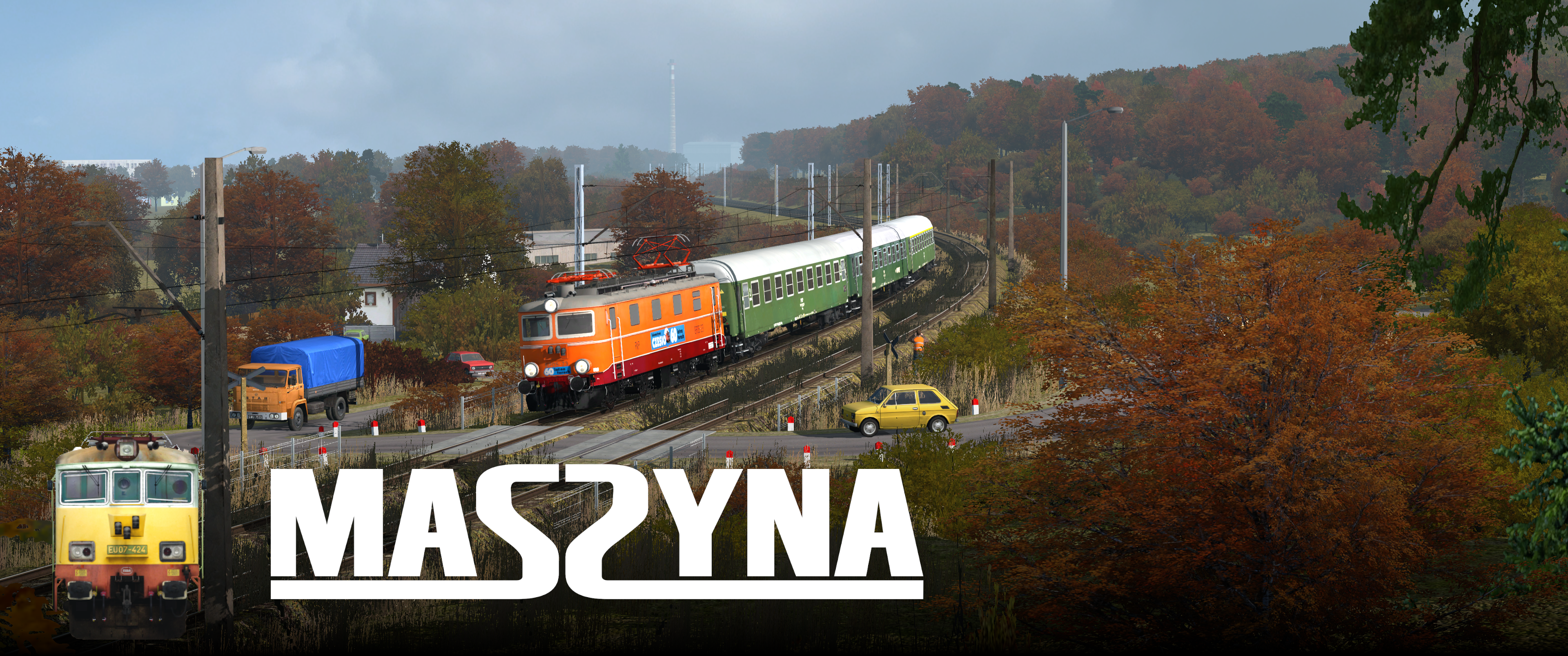
MaSzyna - Railway vehicle simulator
Website · Report an issue · Community Discord · MaSzyna on Steam · MaSzyna on Epic Games Store














MaSzyna executable source code is licensed under the MPL 2.0 and comes with a large pack of free assets under a custom license.
Table of Contents
Getting Started
MaSzyna compiles and runs natively on Linux and Windows. Other platforms are not tested.
Heads-up
Our dev team is small; we keep improving the build process, but issues may still occur. If you get stuck, please ask on the official Discord server.
Prerequisites
For runtime requirements see Minimum Requirements.
1) Software (oldest tested in parentheses)
Note: MinGW is currently not supported.
2) Libraries (oldest tested in parentheses)
-
GLFW 3.x (3.2.1)
If a link error occurs, pass-DGLFW3_LIBRARIES="<path>"to CMake. -
GLM (0.9.9.0)
-
libserialport (0.1.1)
-
libsndfile (1.0.28)
-
LuaJIT (2.0.5)
-
GLEW (2.1.0)
-
libpng (1.6.34)
-
OpenAL (1.18.2)
-
pthread
-
Python 3.14 (64-bit; headers and import library required for embedding)
-
Asio (1.12)
3) Graphics API
- OpenGL 3.0 or newer
- DirectX 12 via NVRHI (optional, Windows only, for Better Renderer)
CMake flags
| Flag | Meaning |
|---|---|
-DCMAKE_BUILD_TYPE=Debug |
Debug build |
-DCMAKE_BUILD_TYPE=Release |
Release build |
-DCMAKE_BUILD_TYPE=RelWithDebInfo |
Release build with debug symbols |
-DWITH_BETTER_RENDERER=ON/OFF |
Enable/disable NVRHI-based renderer |
-DUSE_SYSTEM_JSON=ON/OFF |
Use an installed nlohmann_json 3.9 or newer (e.g. nlohmann-json3-dev, vcpkg nlohmann-json) instead of the ref/json submodule (default OFF) |
-DPython3_ROOT_DIR=<path> |
Root of the Python 3.14 install on Windows (python.exe, Lib, DLLs) for embed/copy steps; on Linux, optional if CMake picks the wrong interpreter |
Linux note:
WITH_BETTER_RENDERERuses DirectX 12 through NVRHI and is not supported on Linux.
Windows
Install Python 3.14 x64 from python.org and include the optional Python native development feature (headers and .lib for embedding). Pass -DPython3_ROOT_DIR="C:\Path\To\Python314" on the cmake line when you want the layout under that directory used for embedding and for copying Lib / DLLs next to the executable. The cab screens are drawn with Pillow: install it into that Python (python -m pip install Pillow) before building, so it is copied along with Lib.
AppVeyor CI builds with the worker image’s preinstalled Python at C:/Python314-x64 (see appveyor.yml: -DPython3_ROOT_DIR=...).
# Clone repository with submodules
git clone --recursive https://github.com/MaSzyna-EU07/maszyna.git

cd maszyna

# Init vcpkg
call setup.bat

# Create directory for CMake build files
mkdir build
cd build

# Generate CMake project (replace %CONFIG% with Debug/Release/RelWithDebInfo)
cmake .. -G "Visual Studio 17 2022" -A x64 -DCMAKE_BUILD_TYPE=%CONFIG%

# Build (replace %CONFIG% accordingly)
cmake --build . --config %CONFIG% --parallel
Linux
# Install dependencies (Fedora/RHEL family)
sudo dnf install -y \
  @development-tools \
  cmake \
  mesa-libGL-devel \
  glew-devel \
  glfw-devel \
  python3.14-devel \
  libpng-devel \
  openal-soft-devel \
  luajit-devel \
  libserialport-devel \
  libsndfile-devel \
  gcc \
  g++ \
  wayland-devel \
  wayland-protocols-devel \
  libxkbcommon-devel

# Clone repository with submodules
git clone --recursive https://github.com/MaSzyna-EU07/maszyna.git

cd maszyna

# Create directory for CMake build files
mkdir build
cd build

# Generate Makefiles (NVRHI is not supported on Linux)
cmake .. -DWITH_BETTER_RENDERER=OFF

# Compile using all cores
make -j"$(nproc)"
Tip (Ubuntu/Debian): Package names differ; install equivalent
build-essential,libgl1-mesa-dev,libglew-dev,libglfw3-dev,python3.14-dev,libpng-dev,libopenal-dev,libluajit-5.1-dev,libserialport-dev,libsndfile1-dev, and Wayland/X11 dev packages as needed.
Installing
There is no make install yet. Copy the built executable to your MaSzyna installation manually.
-
Output directory:
./bin -
File name format:
eu07_YYYY-MM-DD_<commit>[_d]-
YYYY-MM-DD– build date -
<commit>– short commit hash -
_d– present in Debug builds
-
If you already have the MaSzyna assets, copy the executable to the install dir. Assets can be downloaded from eu07.pl.
Rainsted on Linux
If Rainsted (a third‑party starter) fails to detect the executable under Linux, you can create a small wrapper script named eu07.exe:
#!/bin/sh
./eu07 "$1" "$2" "$3" "$4" "$5"
If detection still fails, padding the file (with comments) up to ~1 MB may help.
Known Issues
-
GLFW linking – On some systems you must provide the GLFW library path explicitly with
-DGLFW3_LIBRARIES. -
X11/Wayland linking order – Linking order of X11 and related libs can matter.
-
NVRHI on Linux – The NVRHI/"Better Renderer" path targets DirectX 12 and is currently unsupported on Linux.
Support
-
Official Discord Server: https://discord.gg/qAh9ctWPQv
-
Project page: https://eu07.pl/
Minimum requirements
- OS: Windows 10 64-bit
- Processor: 4 cores with AVX2 support (e.g. Intel Core i5-4430 / AMD Ryzen 3 1200)
- RAM: 6 GB RAM
- Graphics Card: supporting OpenGL 3.3 with at least 1GB VRAM
- 150 GB of free disk space
- Sound card supporting OpenAL with stereo
- Optional COM ports for custom control panel setups.
License
-
Source code: MPL 2.0
-
Assets: Custom license