 Hirek193
4870935983
Hirek193
4870935983
Every peer used to evaluate event conditions for itself and put the results
straight into its own queue, so the same event could fire twice, or on one
machine only. Worse, the launchers were polled around Global.pCamera, which in
a session means "wherever one particular player happens to be looking".

Condition evaluation is now separated from execution:

    authority:  evaluate -> queueevent -> execute -> replicate
    client:     receive queueevent -> execute

- AddToQuery() takes the origin of the request. A locally evaluated launch on a
  client is dropped, on the host it is handed to the session as the ordinary
  queueevent command and comes back to be carried out by everybody, itself
  included, so it happens exactly once per peer. Scenario init (onstart,
  negative delay) and the children of an already replicated event are marked as
  authority decisions and run in place, since they are identical everywhere.
  With no session running, both branches collapse to the old behaviour
- queueevent now carries the delay as well
- event launchers are polled around every crewed vehicle instead of around the
  local camera, and a cell is polled at most once per frame no matter how many
  players stand near it - launcher activation counters are stateful
- Events.update() still services the queue on a client, with its delays and its
  execution; only the condition checking is skipped there

An event whose request is still travelling is not requested again, with a
timeout so that a lost request cannot silence it for good. Instant (AddValues)
events are exempt from that guard, because every one of their additions has to
get through.
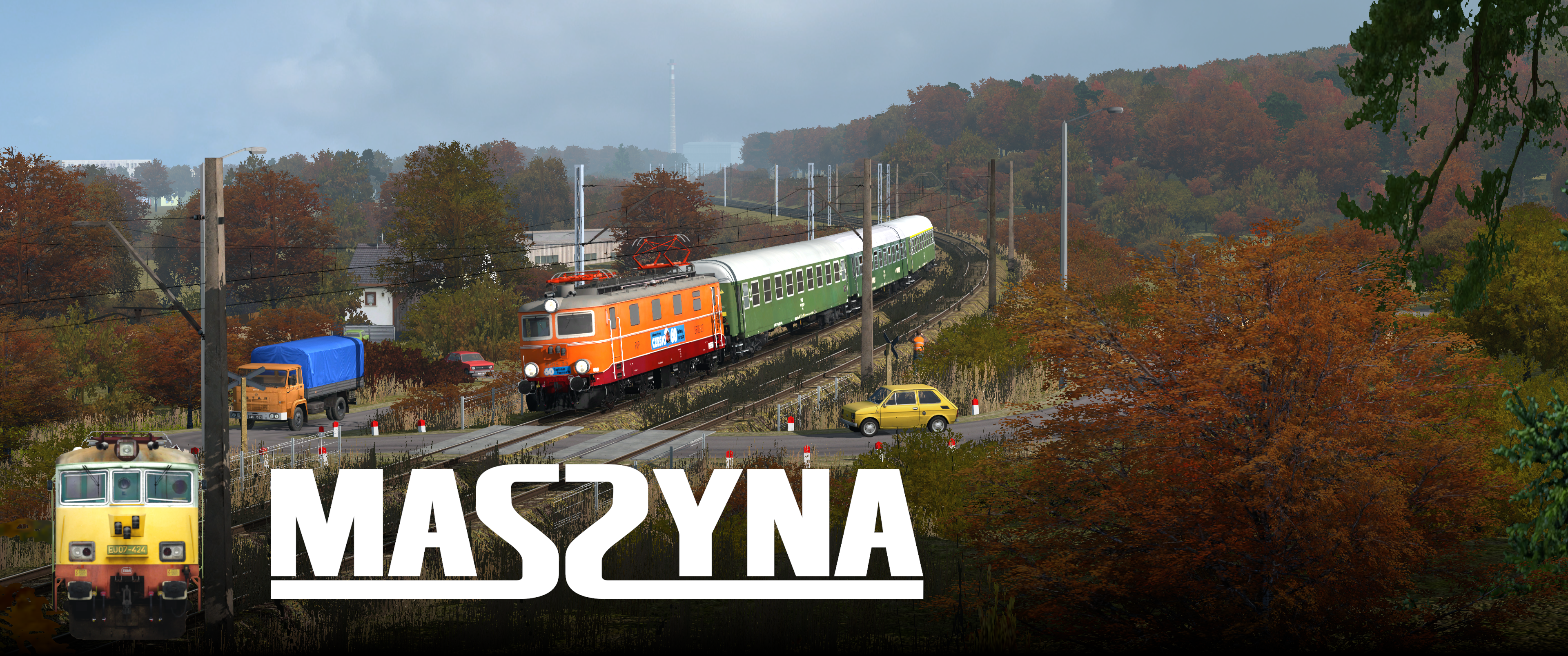
MaSzyna - Railway vehicle simulator
Website · Report an issue · Community Discord · MaSzyna on Steam · MaSzyna on Epic Games Store














MaSzyna executable source code is licensed under the MPL 2.0 and comes with a large pack of free assets under a custom license.
Table of Contents
Getting Started
MaSzyna compiles and runs natively on Linux and Windows. Other platforms are not tested.
Heads-up
Our dev team is small; we keep improving the build process, but issues may still occur. If you get stuck, please ask on the official Discord server.
Prerequisites
For runtime requirements see Minimum Requirements.
1) Software (oldest tested in parentheses)
Note: MinGW is currently not supported.
2) Libraries (oldest tested in parentheses)
-
GLFW 3.x (3.2.1)
If a link error occurs, pass-DGLFW3_LIBRARIES="<path>"to CMake. -
GLM (0.9.9.0)
-
libserialport (0.1.1)
-
libsndfile (1.0.28)
-
LuaJIT (2.0.5)
-
GLEW (2.1.0)
-
libpng (1.6.34)
-
OpenAL (1.18.2)
-
pthread
-
Python 3.14 (64-bit; headers and import library required for embedding)
-
Asio (1.12)
3) Graphics API
- OpenGL 3.0 or newer
- DirectX 12 via NVRHI (optional, Windows only, for Better Renderer)
CMake flags
| Flag | Meaning |
|---|---|
-DCMAKE_BUILD_TYPE=Debug |
Debug build |
-DCMAKE_BUILD_TYPE=Release |
Release build |
-DCMAKE_BUILD_TYPE=RelWithDebInfo |
Release build with debug symbols |
-DWITH_BETTER_RENDERER=ON/OFF |
Enable/disable NVRHI-based renderer |
-DPython3_ROOT_DIR=<path> |
Root of the Python 3.14 install on Windows (python.exe, Lib, DLLs) for embed/copy steps; on Linux, optional if CMake picks the wrong interpreter |
Linux note:
WITH_BETTER_RENDERERuses DirectX 12 through NVRHI and is not supported on Linux.
Windows
Install Python 3.14 x64 from python.org and include the optional Python native development feature (headers and .lib for embedding). Pass -DPython3_ROOT_DIR="C:\Path\To\Python314" on the cmake line when you want the layout under that directory used for embedding and for copying Lib / DLLs next to the executable.
AppVeyor CI builds with the worker image’s preinstalled Python at C:/Python314-x64 (see appveyor.yml: -DPython3_ROOT_DIR=...).
# Clone repository with submodules
git clone --recursive https://github.com/MaSzyna-EU07/maszyna.git

cd maszyna

# Init vcpkg
call setup.bat

# Create directory for CMake build files
mkdir build
cd build

# Generate CMake project (replace %CONFIG% with Debug/Release/RelWithDebInfo)
cmake .. -G "Visual Studio 17 2022" -A x64 -DCMAKE_BUILD_TYPE=%CONFIG%

# Build (replace %CONFIG% accordingly)
cmake --build . --config %CONFIG% --parallel
Linux
# Install dependencies (Fedora/RHEL family)
sudo dnf install -y \
  @development-tools \
  cmake \
  mesa-libGL-devel \
  glew-devel \
  glfw-devel \
  python3.14-devel \
  libpng-devel \
  openal-soft-devel \
  luajit-devel \
  libserialport-devel \
  libsndfile-devel \
  gcc \
  g++ \
  wayland-devel \
  wayland-protocols-devel \
  libxkbcommon-devel

# Clone repository with submodules
git clone --recursive https://github.com/MaSzyna-EU07/maszyna.git

cd maszyna

# Create directory for CMake build files
mkdir build
cd build

# Generate Makefiles (NVRHI is not supported on Linux)
cmake .. -DWITH_BETTER_RENDERER=OFF

# Compile using all cores
make -j"$(nproc)"
Tip (Ubuntu/Debian): Package names differ; install equivalent
build-essential,libgl1-mesa-dev,libglew-dev,libglfw3-dev,python3.14-dev,libpng-dev,libopenal-dev,libluajit-5.1-dev,libserialport-dev,libsndfile1-dev, and Wayland/X11 dev packages as needed.
Installing
There is no make install yet. Copy the built executable to your MaSzyna installation manually.
-
Output directory:
./bin -
File name format:
eu07_YYYY-MM-DD_<commit>[_d]-
YYYY-MM-DD– build date -
<commit>– short commit hash -
_d– present in Debug builds
-
If you already have the MaSzyna assets, copy the executable to the install dir. Assets can be downloaded from eu07.pl.
Rainsted on Linux
If Rainsted (a third‑party starter) fails to detect the executable under Linux, you can create a small wrapper script named eu07.exe:
#!/bin/sh
./eu07 "$1" "$2" "$3" "$4" "$5"
If detection still fails, padding the file (with comments) up to ~1 MB may help.
Known Issues
-
GLFW linking – On some systems you must provide the GLFW library path explicitly with
-DGLFW3_LIBRARIES. -
X11/Wayland linking order – Linking order of X11 and related libs can matter.
-
NVRHI on Linux – The NVRHI/"Better Renderer" path targets DirectX 12 and is currently unsupported on Linux.
Support
-
Official Discord Server: https://discord.gg/qAh9ctWPQv
-
Project page: https://eu07.pl/
Minimum requirements
- OS: Windows 10 64-bit
- Processor: 2 core at least 2 GHz (e.g. Intel Core i3-2100 / AMD Athlon II X2)
- RAM: 6 GB RAM
- Graphics Card: supporting OpenGL 3.3 with at least 1GB VRAM
- 150 GB of free disk space
- Sound card supporting OpenAL with stereo
- Optional COM ports for custom control panel setups.
License
-
Source code: MPL 2.0
-
Assets: Custom license